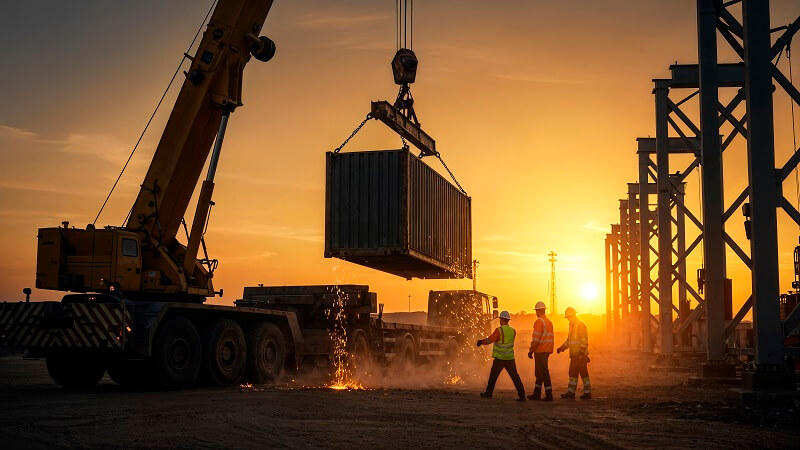
Modern infrastructure is often judged by what we can see: soaring bridges, expanding ports, wind farms rising from coastlines, and skylines reshaped by ever-taller buildings. What is often overlooked is the complex world of heavy-lifting and rigging technology that makes all of this possible. Long before a project becomes a symbol of progress, teams of engineers, riggers, and lift planners address a fundamental challenge: how to safely and precisely move massive loads in environments where errors are not an option.
As global infrastructure projects grow in scale and complexity, heavy-lift technology has become a critical driver of economic development, urban expansion, and international connectivity.
Infrastructure Growth Starts With the Ability to Lift
Every major infrastructure project, whether it is a power plant, transit system, port expansion, or manufacturing facility, depends on the ability to precisely position heavy components where they are needed. Steel beams, precast concrete sections, turbines, generators, and modular assemblies are often too large and too heavy to be moved by conventional methods.
This is where modern lifting systems come in. Cranes, hoists, and engineered rigging assemblies enable construction teams to handle loads weighing tens or even hundreds of tons with millimeter-level accuracy. Without these tools, large-scale infrastructure could not be built efficiently, or in many cases, at all.
The Global Nature of Heavy Lifting
Infrastructure is no longer a purely local endeavor. Components are often manufactured in one country, shipped across oceans, and assembled in another. Ports, shipyards, rail terminals, and logistics hubs rely heavily on advanced lifting technology to maintain the flow of materials through global supply chains.
At shipping ports, heavy-lift systems are used to install container cranes, lift oversized cargo, and maintain critical equipment. In energy projects, massive transformers and turbine components must be lifted into place at remote sites. In urban environments, lifting operations are carefully planned to avoid disrupting surrounding buildings, roads, and utilities.
This global movement of heavy equipment requires standardized rigging practices, internationally recognized safety margins, and reliable tools that perform consistently across diverse climates and working conditions.
Rigging Tools That Make Global Projects Possible
While cranes often get the spotlight, rigging equipment performs the quiet, precise work of connecting loads to lifting machines. Several key tools play a major role in modern infrastructure projects.
Wire rope slings are among the most widely used rigging tools worldwide. Known for their strength, durability, and abrasion resistance, they are commonly used to lift steel structures, heavy machinery, and prefabricated components. Their flexibility enables them to accommodate complex load shapes while maintaining stability.
Chain slings are essential in environments requiring durability and resistance to heat or sharp edges. They are frequently used in industrial plants, power generation facilities, and heavy manufacturing settings where conditions are harsh and loads are irregular.
Synthetic slings, including web slings and round slings, are increasingly popular for lifting finished components or painted surfaces. Their lightweight construction makes them easier to handle on large job sites, and their flexibility reduces the risk of surface damage during critical lifts.
Shackles are the backbone of many rigging assemblies, connecting slings, hooks, and lifting points into a secure system. Whether used with anchor shackles or chain shackles, these small components play a significant role in load control and safety.
Rigging hooks, including self-locking and swivel hooks, enable controlled attachment and release of loads. In complex lifts where alignment matters, swivel hooks help reduce twisting and improve load positioning.
Precision Lifting Enables Faster Project Timelines
One of the most important contributions of modern heavy-lifting technology is improved efficiency. Infrastructure projects often operate on tight schedules with high financial stakes. Delays can ripple through supply chains and affect entire regions.
Engineered lifting systems enable teams to lift larger assemblies in fewer operations. Modular construction techniques rely heavily on heavy lifting equipment to place large sections quickly, reducing on-site labor and minimizing risk exposure. A single well-planned lift using spreader beams, multiple slings, and load-balancing devices can replace dozens of smaller, time-consuming operations.
This ability to move faster without sacrificing safety is a key reason heavy lifting technology is so closely tied to infrastructure growth worldwide.
Safety as a Foundation for Progress
Infrastructure growth is unsustainable without safety. As lifting operations become more complex, the margin for error narrows. Modern rigging technology addresses this challenge through improved materials, better design, and advanced inspection methods.
Load-rated hardware, clearly defined working load limits, and standardized inspection procedures help ensure that every component in a rigging system performs as intended. Tools such as load-monitoring devices and dynamometers enable teams to verify actual forces during a lift, providing an additional layer of confidence when handling critical loads.
In many regions, adopting modern lifting standards has directly reduced accident rates and improved worker protection. Safer job sites attract skilled labor, support the long-term viability of projects, and help maintain public trust in large infrastructure investments.
Supporting Renewable Energy and Sustainable Development
Global infrastructure growth is increasingly focused on sustainability, and heavy-lifting technology plays a vital role in that transition. Wind turbines, solar installations, hydroelectric facilities, and energy storage systems all depend on lifting equipment capable of handling oversized, high-value components.
Wind turbine towers, nacelles, and blades require precise rigging to prevent damage during installation. In solar projects, lifting frames and specialty rigging tools are used to position large assemblies efficiently. Even during maintenance and upgrades, lifting technology ensures that renewable energy assets remain operational throughout their long service lives.
Without reliable lifting solutions, many renewable energy projects would incur higher costs, longer timelines, and greater risk.
Building the Future One Lift at a Time
From transportation networks and industrial facilities to energy systems and urban development, heavy-lifting technology underpins nearly every form of global infrastructure development. It enables engineers to design larger structures, builders to work smarter, and societies to expand their physical foundations safely and efficiently.
While the cranes and rigging tools may fade into the background once a project is complete, their impact remains embedded in the bridges we cross, the power we use, and the systems that keep the world connected. As infrastructure demands continue to grow worldwide, the importance of advanced heavy-lifting and rigging technology will only become more central to how progress is built.