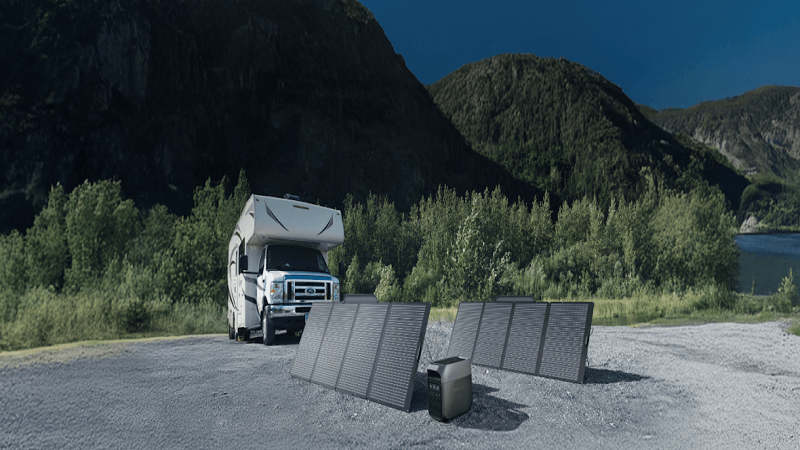
Most people need 1–2 panels for light daily use, 2–4 panels for a fridge-plus-devices setup, and 4–8 panels if they want faster recharging or longer off-grid stays. In practice, the right number depends on four things: your solar generator’s battery capacity (Wh), your daily power use, the generator’s solar input limit (W), and how much sun you actually get.
What determines how many solar panels you need
Your solar generator’s battery capacity
Battery capacity is measured in watt-hours. It defines how much energy you can store, and it sets the ceiling for how much solar input feels “worth it.”
A simple sizing anchor that works for most buyers:
- Small setups: 300–600Wh
- Mid-size everyday setups: 1000–2000Wh
- Larger setups: 2000Wh+
The bigger the battery, the more panel input you can use efficiently, but only if you can physically deploy the panels and your generator can accept the input.
Your daily power consumption
The most important clarity is whether your goal is to offset daily use or fully recharge the battery.
If your goal is daily offset, you usually need fewer panels than you think because you’re trying to keep the battery from dropping, not to take it from empty to full every day. This is the common use case for camping, van life, and weekend trips.
If your goal is full recharge, panel count goes up, and your setup becomes more about solar harvesting than just backup power.
Your generator’s solar input limit
This is the spec that decides the maximum useful panel count. Many people buy more panels than their solar generator can actually accept.
A generator might support, for example, 200W, 400W, 800W, or higher solar input. If your unit can only take 400W, adding panels beyond that does not speed up charging in a meaningful way.
When you’re deciding “how many panels,” you’re really deciding “how many watts of solar input” within the unit’s supported range.
Your real-world sunlight
Solar panels rarely deliver their full rated output all day. Weather, season, panel angle, temperature, and shading change the real input dramatically.
That’s why panel sizing is usually done as a range rather than a single number. You want enough input to make the system feel reliable even when conditions aren’t perfect, especially in shoulder seasons.
Typical solar panel setups by use case
Below are practical, search-friendly ranges that match how people actually use solar generators. These are not formulas; they are decision anchors.
Small solar generator setups
If you mainly charge phones, a laptop, lights, and cameras, a total solar input around 100–200W is usually enough. That often means:
- 1 × 100W, or
- 1 × 200W
This setup is popular because it is light, quick to deploy, and still meaningfully reduces dependence on wall power.
Medium solar generator setups
If you run a portable fridge plus daily devices and lighting, a total solar input around 200–400W is a common sweet spot. That often means:
- 2 × 100W, or
- 1 × 200W, or
- 1 × 400W (when portability allows)
This is the range many van life and road trip users rely on, because it can cover “daily offset” for a fridge, charging, and basic lighting under decent sun.
Larger solar generator setups
If you have a large battery, longer off-grid stays, or you want faster charging recovery, you typically move into 400–800W of solar input or more, which can mean:
- 2 × 200W, or
- 1–2 × 400W, or
- 4–8 × 100W depending on space and portability
At this scale, setup practicality matters as much as raw watts. More panels can help, but only if you can deploy them consistently.
Do you need enough panels to fully recharge every day?
Most users do not. For camping, van life, and weekend travel, a solar generator usually works best as a system that stays “stable” rather than one that returns to 100% every day.
If your goal is to keep the battery from dropping too fast, 200–400W often feels like a major upgrade in real life because it reduces how often you need to drive, find shore power, or ration device use.
Full daily recharge matters more when you are living off-grid for long stretches and you do not have reliable driving or grid charging opportunities. That is where larger solar arrays and higher input limits become worth it.
How panel size affects panel count
Choosing between 100W, 200W, and 400W panels is less about performance and more about how you live.
100W panels
These are easier to carry and place, and they fit smaller setups well. The trade-off is that you may need multiple panels to reach meaningful input.
200W panels
This is a common balance point. You can reach the useful 200–400W range without carrying too many separate panels.
400W panels
These reduce panel count quickly, but they are physically larger and less flexible to deploy. They make the most sense when you have space and you want fewer components.
Common mistakes when choosing solar panels for a solar generator
A frequent mistake is oversizing panels without checking the generator’s solar input limit. Another is undersizing and expecting one small panel to cover a fridge and daily charging reliably.
The third mistake is ignoring setup reality. If a panel setup is annoying to deploy, people stop using it, and then the solar generator becomes a wall-charged battery again.
Quick decision checklist
If you want a fast answer without overthinking, use these checkpoints:
- Battery capacity: 300–600Wh, 1000–2000Wh, or 2000Wh+
- Solar input limit: what total watts your generator accepts
- Goal: daily offset vs full recharge
- Deployment: how many panels you will realistically set up every day
Final answer
You need solar panels that match your solar generator’s input limit and your real daily use, not just the battery size. For most users, 100–200W covers light charging, 200–400W is the practical sweet spot for fridge-plus-devices daily offset, and 400–800W is for faster recovery and longer off-grid stays.
If you tell me your solar generator’s Wh capacity and its solar input limit in watts, I can give you a one-line recommendation for “how many panels” in exactly the same anchor style, without turning it into a calculation tutorial.